PRODUCT INFORMATION
Product Overview
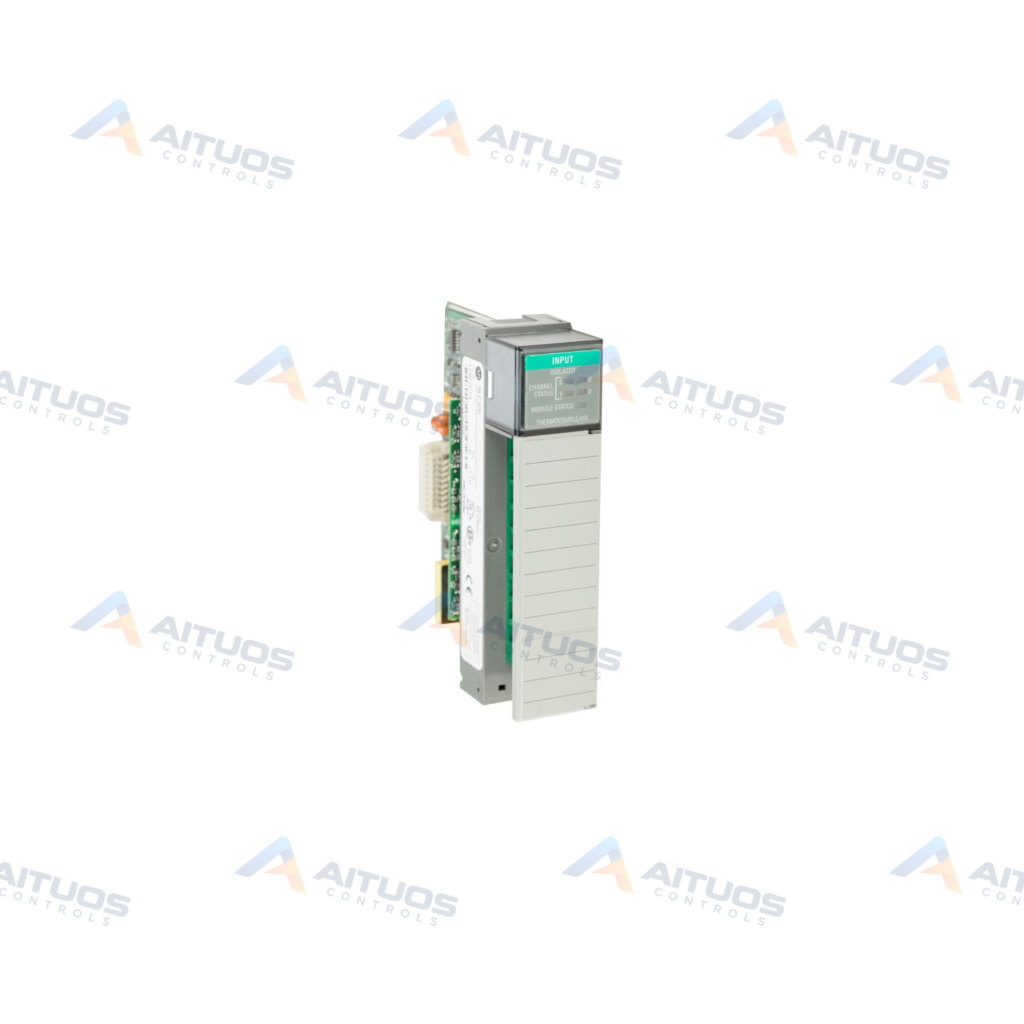
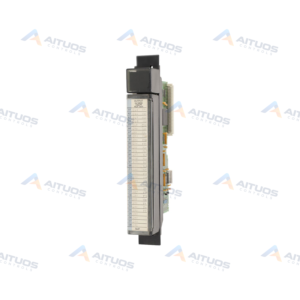
The Allen-Bradley 1746-INT4 is an SLC 500 Analog Input Module designed for thermocouple and millivolt sensor connections. It features four individually isolated input channels that are also isolated from the chassis backplane. The module converts analog inputs using a Sigma-Delta analog-to-digital modulation method with sixteen-bit resolution. Digitally converted sensor data is stored internally for retrieval by any SLC 500 processor. Operating power draws 110 mA at 5V DC and 85 mA at 24V DC from the backplane.
Channel isolation is tested at 1000V transient or 150V AC channel-to-channel and channel-to-backplane. An integrated cold junction compensation terminal delivers accuracy within plus or minus 1.5 degrees Celsius. Five front-panel LED indicators display individual channel status and overall module operation. The unit provides open-circuit detection with configurable upscale, downscale, or zero indications. Field calibration is required at least once per year to preserve analog measurement integrity.
TECHNICAL DATA
Technical Specifications
| Parameter | Specification |
|---|
| Backplane Current | 110 mA @ 5VDC; 85 mA @ 24VDC |
|---|
| Backplane Current (24 Volts) | 85 milliamps |
|---|
| Backplane Current (5 Volts) | 110 milliamps |
|---|
| Bandwidth | 8 Hertz |
|---|
| Category | PLCs |
|---|
| Cold junction compensation | Accuracy ±1.5 °C (34.7 °F), 0 … 70 °C (32…158 °F) |
|---|
| Inputs | Four (4); Isolated |
|---|
| Module Type | Isolated Thermalcouple/mV Analog Input Module |
|---|
| Open circuit detection time | 5 s, typical |
|---|
| Open-circuit detection | Upscale, downscale, or zero |
|---|
| Resolution | 16 Bits |
|---|
| Step Response | 100 milliseconds in, 2.5 milliseconds out |
|---|
| Thermocouple Linearization | IPTS–68 standard, NBS MN–125, NBS MN–161 |
|---|
| Thermocouple sensors | Type C, D, J, K, T, E, R, S, B, and N |
|---|
| UPC | 612598169696 |
|---|
| Update Time | 500 milliseconds |
|---|
| Weight | 1.50 lbs (0.68 kg) |
|---|
| mV signal inputs | –50…50 mV dc –100…100 mV dc |
|---|
TECHNICAL INFORMATION
Features
- Four individually isolated analog input channels for thermocouple and millivolt sensors.
- Sigma-Delta analog-to-digital converter architecture with 16-bit resolution.
- Channel-to-channel and channel-to-backplane isolation tested at 1000V transient or 150V AC.
- Integrated cold junction compensation accurate to plus or minus 1.5 degrees Celsius.
- User-selectable temperature reporting in Celsius or Fahrenheit scales.
- Selectable open-circuit fault detection configurable to upscale, downscale, or zero.
- Normal mode noise rejection greater than 60 dB at 60 Hz.
- Common mode noise rejection greater than 120 dB between inputs and chassis ground.
- Five front LED indicators providing module and individual channel diagnostics.
TECHNICAL INFORMATION
Applications
- Temperature measurement across ranges from -270 to 1820 degrees Celsius using compatible thermocouples.
- Direct acquisition of low-voltage DC signals from millivolt transducers.
- Process monitoring in SLC 500 programmable logic controller systems.
TECHNICAL INFORMATION
Connections / Interfaces
- Four isolated differential input channel terminal pairs.
- Integrated cold junction compensation terminal block connections.
- Direct edge connector interface to the SLC 500 chassis backplane.
TECHNICAL INFORMATION
Installation Guidelines
- Insert the module into any available slot within an SLC 500 chassis.
- Disconnect chassis power before inserting or removing the input module.
- Maintain an operating ambient temperature between 0 and 60 degrees Celsius.
- Operate the unit in environments with 5 to 95 percent non-condensing relative humidity.
TECHNICAL INFORMATION
Configuration Guidelines
- Configure each channel for thermocouple types B, C, D, E, J, K, N, R, S, or T.
- Select input ranges of -50 to 50 mV DC or -100 to 100 mV DC for millivolt transducers.
- Choose temperature engineering units in Celsius or Fahrenheit with tenths-degree resolution.
- Set open-circuit fault response to maximum upscale, downscale, or zero values.
TECHNICAL INFORMATION
Compatibility
- Compatible with SLC 500 processors across standard SLC 500 chassis hardware.
- Supports thermocouple sensor types B, C, D, E, J, K, N, R, S, and T.
- Accepts DC millivolt input signals spanning -50 to 50 mV and -100 to 100 mV.
TECHNICAL INFORMATION
Lifecycle / Replacement Information
- The module belongs to the legacy Allen-Bradley SLC 500 control system family.
- Existing installations can replace damaged modules with identical 1746-INT4 units.
TECHNICAL INFORMATION
Compliance and Certifications
COMPATIBILITY
Compatibility & Replacement
COMPATIBLE MODELSCompatible with SLC 500 processors across standard SLC 500 chassis hardware. Supports thermocouple sensor types B, C, D, E, J, K, N, R, S, and T. Accepts DC millivolt input signals spanning -50 to 50 mV and -100 to 100 mV.
Verify compatibility against the exact Part Number, revision and manufacturer documentation before ordering.
PART VERIFICATION
Before You Order
Industrial automation parts can share similar model names, suffixes and revisions. Confirm the complete manufacturer Part Number before purchase.
01Check Part NumberMatch the complete ordering code on the existing unit.
02Confirm RevisionCheck suffix, hardware or firmware when applicable.
03Send a Label PhotoWe can review a clear label photo when identification is uncertain.
ORDERING PROCESS
From RFQ to Dispatch
1Submit Part Number2Verify Product Identity3Confirm Stock & Condition4Issue Quotation5Dispatch & Tracking
PRODUCT FAQ
Frequently Asked Questions
What thermocouple types are supported by the 1746-INT4 module?
The module supports thermocouple types B, C, D, E, J, K, N, R, S, and T.
What power does the 1746-INT4 consume from the SLC 500 backplane?
The module draws 110 mA at 5V DC and 85 mA at 24V DC from the backplane.
How does the module respond to an open-circuit sensor fault?
Fault detection flags open circuits and drives channel data to upscale, downscale, or zero.
What calibration interval is recommended for the 1746-INT4?
The module requires field calibration at least once every year to maintain accuracy.